
Automation vs. Autonomous
From Task Execution to Outcome Ownership

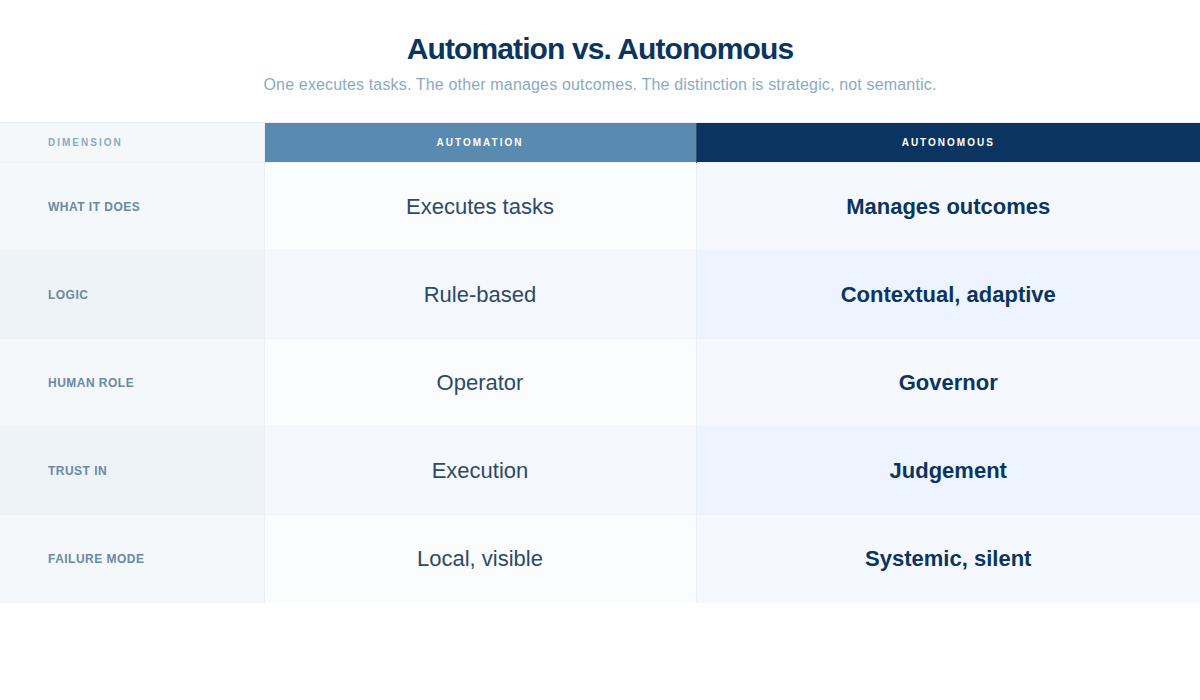
Automation executes tasks. Autonomous systems manage outcomes. That’s not a semantic distinction. It’s a completely different relationship between the system and the work.
Think about cruise control versus a self-driving car. Cruise control does exactly what you tell it: hold this speed. Done. A self-driving car is reading the road, watching other vehicles, making continuous judgment calls about what happens next. Don’t hit the kid on the bike. Do stop at Starbucks. Same highway.
One makes the wrong work faster. The other changes what the work is. Confuse the two and you’ve got a half-assed strategy for both.
Automation fires when triggered. Rules, scope, trigger, output. It’s fast, reliable, and completely indifferent to what happens next. Autonomous systems read context, weigh tradeoffs, and adapt toward a goal. One reduces effort. The other reduces the burden of deciding. Those are not the same thing, and building for one when you need the other is how you end up with a very fast system solving the wrong problem.
The Planner in the Car
It’s 7:45am. A demand planner is twenty minutes from the office, coffee going cold in the cupholder, already dreading the 400 exceptions waiting in the queue. Under the old model, the planner might not know what actually matters until they’ve been at their desk for two hours. Running reports. Cross-referencing spreadsheets. Figuring out which fire is just smoke and which one is about to spread.
With an autonomous system, that morning—and every morning—looks different. The system worked overnight: watching demand shifts, weighing inventory positions, flagging what needs a human decision, and reporting what it’s already handled. By the time the planner hits the parking garage, they’ve had a voice briefing with the AI agent. They know what’s broken and why. They walk in ready to act.
That’s not automation. Automation didn’t change their morning—it just processed the data faster. Autonomy changed what the job actually is. The planner isn’t running the process anymore. They’re governing it.
Why Trust Is Where It Gets Messy
Trusting automation means believing the system will execute correctly. That’s a reliability question. You test it, it works, and you move on.
Trusting an autonomous system means believing it will make a sound judgment under uncertainty. That’s a much harder thing to earn—and most enterprise software was never built to try. When it botches that trust, the consequences aren’t local. They’re systemic and insidious, quietly downstream before anyone catches them. By the time it surfaces, it’s a debacle with a calendar invite attached.
That’s not a reason to slow down. It’s a reason to build observability, reversibility, and clear policy boundaries into the experience from the start. Not as audit logs nobody opens, but as the actual interface.
What Design Is Actually Responsible For
The UX of mission-critical enterprise software has been a hot mess for a long time. Cluttered dashboards. Forty-column tables. Screens built around the system’s logic, not the person using it. We’ve accepted that as the cost of complexity. We shouldn’t, and with autonomous systems in the mix, we really can’t afford to anymore.
In the era of automation, UX was about task execution and error recovery. That work still exists, but it’s not the hard part.
The hard part is intent and governance. Helping people express what they’re optimizing for. Making system reasoning visible at the right altitude. Giving people the ability to intervene without the whole thing turning into a fiasco every time they do. When a system is making hundreds of decisions an hour, nobody’s reviewing each one. The experience has to let people set parameters, read patterns, catch the exceptions that matter, and trust the rest.
That’s a different design problem than a workflow. It’s the relationship between a person and a system with real agency.
Design is what encodes that trust into the system from the start—not bolted on after the first crisis. That’s the difference between a system that earns more authority over time and one that quietly gets worked around.
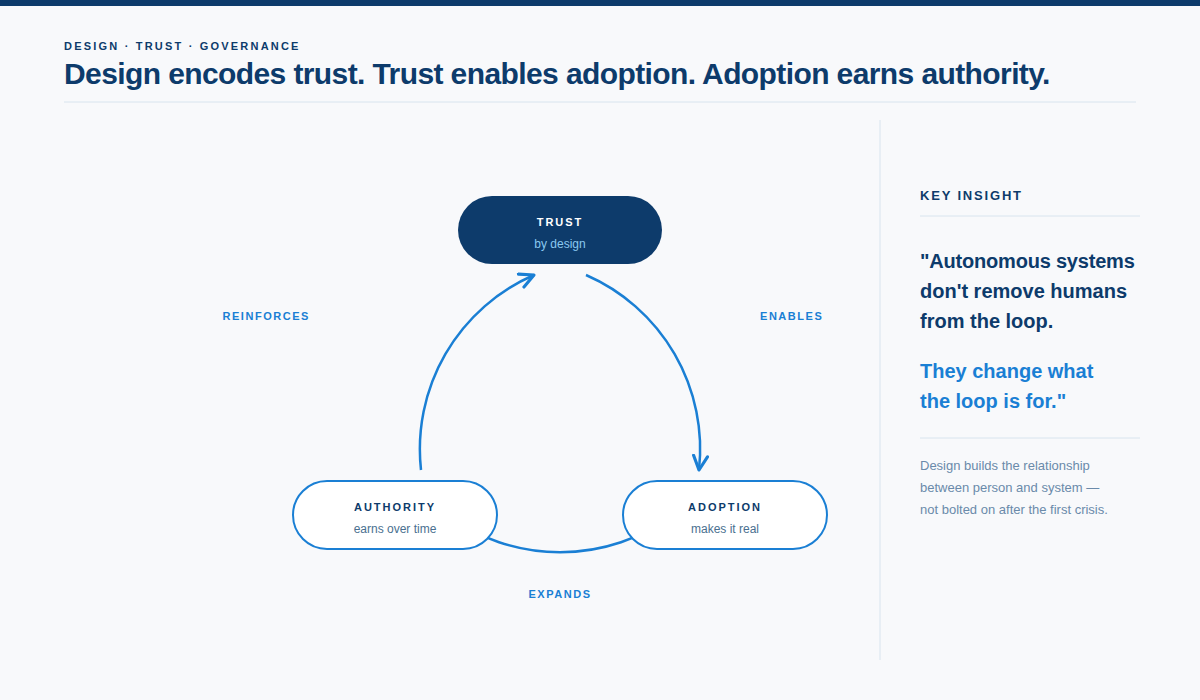
But only adoption makes it real. And adoption doesn’t happen without trust. Trust doesn’t happen without design that was built for this from the beginning.
The planner in the parking garage isn’t a better planner because the system is faster. They’re a better planner because the system took the right things off their plate and left them the ones that matter.
Autonomous systems don’t remove humans from the loop. They change what the loop is for.
NOTE: This piece was developed with the assistance of AI. The perspective, judgment, and conclusions are my own. The tools are new and powerful; the responsibility for thinking, judgment, and meaning remains human.
 | A guest post by
|