
Using Design to Maximize Supply Chain Sustainability Performance

Supply chain leaders rely on Blue Yonder to solve an increasingly complex equation: deliver on traditional performance goals like cost, efficiency, and resilience, while also evolving to measure and reduce environmental impact. Increasingly, executives and practitioners are expected to balance mitigating carbon emissions and waste while maximizing traditional KPIs.
For designers, the challenge is to anticipate this shift and create workflows that make managing sustainability an intuitive part of the broader supply chain management context. Good design does more than visualize data; it helps decision-makers see relationships and act with confidence. As sustainability becomes a leadership priority, designers must think creatively about how to embed this new dimension into the user experience without overwhelming users who are already managing multiple layers of complexity.
Integrating Supply Chain and Sustainability KPIs
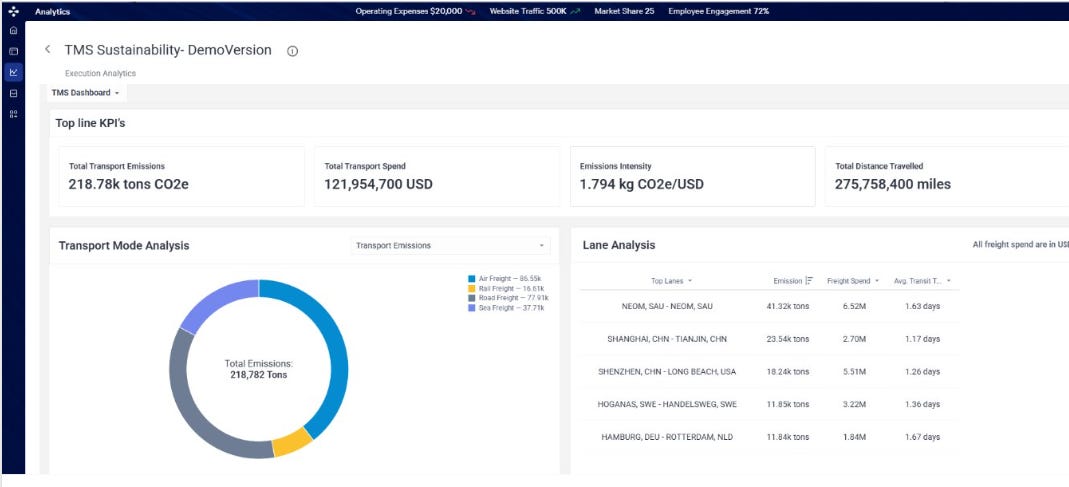
Too often, sustainability metrics live in separate dashboards or periodic reports, disconnected from where operational choices are made. That separation weakens their influence. By embedding carbon and waste KPIs directly alongside cost, lead time, and service metrics, designers can create unified interfaces where trade-offs can be understood holistically. Two examples:
When a planner evaluates whether to expedite freight by air, they should see both the cost and the emissions impact in the same view.
When choosing between multiple suppliers, they should be able to see and compare the sustainability scores of the different suppliers.
When designed well, sustainability becomes not an afterthought but a core measure of supply chain performance, ensuring both operational and environmental KPIs share equal visibility and usability.
Sustainability at Multiple Levels for Different Roles
At the broadest level, supply chain and sustainability executives need visibility into year over year impact, and the ability to understand root cause analysis. At the scenario level, supply chain managers need to understand comparative impact between multiple plans and scenarios, as well as systemic hotspots.
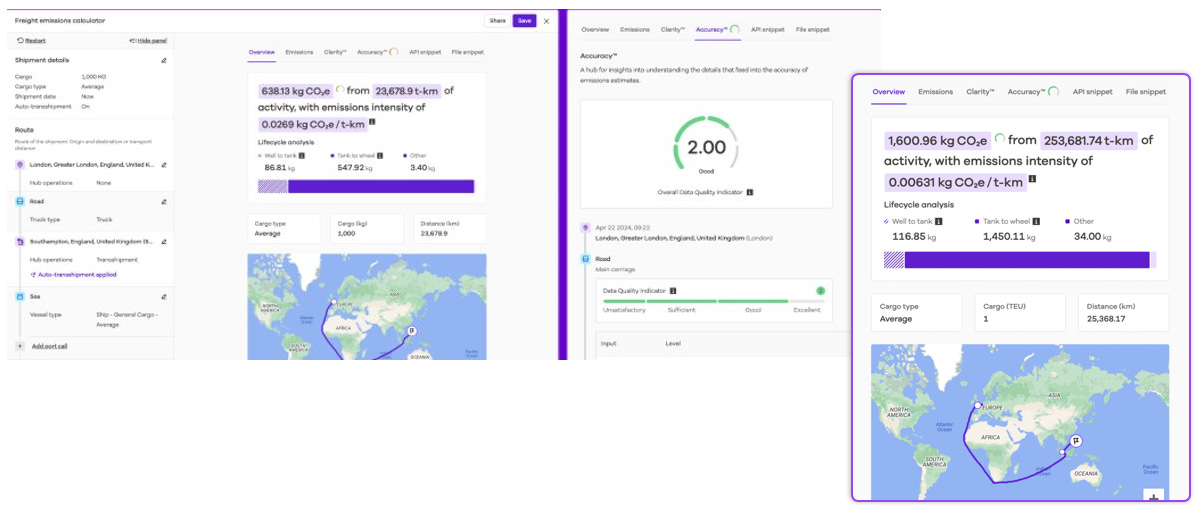
At the transactional level, activity planners must see the impacts of more granular decisions such as carrier selection, supplier choice, or production plan adjustments, where cumulative effects can be significant. Here, design determines whether users perceive sustainability as relevant to their role. A dashboard that reveals emissions trade-offs for alternative carriers, or a planning screen that flags the waste impact of a schedule change, empowers practitioners to conveniently evaluate outcomes holistically. Without thoughtful design, sustainability data can be easily ignored; with good design, the information becomes actionable in the moment.
Building Familiarity Through Interaction
Familiarity comes through repeated interaction. When users consistently see emissions data by default, they begin to internalize patterns just as they do with cost and service performance. Over time, operators may know instinctively which suppliers or modes drive efficiency across all dimensions, including environmental.
Design amplifies this process by ensuring sustainability insights are encountered frequently, presented clearly, and aligned with natural workflows. The more seamless the interaction, the faster organizational fluency grows, moving sustainability from a “new requirement” to a standard lens of performance.
Designers are required to understand what’s important to the user and their success at work. When they do, they have the power to craft interfaces that unify metrics, scale from macro to micro decisions, and encourage repeated interaction with sustainability data. In doing so, they enable operators to make balanced, confident choices that drive measurable progress on corporate business and climate goals.
 | A guest post by
|